Human-AI Interactions Can Amplify Human Bias

Post by Meagan Marks

The takeaway

When AI systems are trained on human biases, they can absorb and amplify them over time. When we interact with these biased systems, our biases may be subliminally strengthened and our perceptual, emotional, and social judgments can be affected.

What's the science?

Artificial Intelligence (AI) is rapidly becoming more prevalent in the workplace, with its use expanding across fields like healthcare, marketing, and education. While AI offers numerous benefits, it is crucial to recognize its potential flaws to improve the technology and maximize its effectiveness. One such flaw is the ability of AI to recognize and mimic human biases, which may influence human perceptual, social, and emotional judgments over time. However, the exact ways in which human biases are introduced into AI systems and, in turn, how these biases affect human judgment—both directly (when using AI as a tool) and indirectly (when passively encountering AI-generated content)— have not been extensively studied. This week in Nature Human Behavior, Glickman and Sharot explore how AI systems learn from human biases, how biased results can influence human judgment across different contexts, and how these AI interactions compare to human-to-human interactions. 

How did they do it?

To test how AI systems influence human judgment, the authors conducted a series of experiments involving emotional, perceptual, and social tasks with 1401 participants total. In the first series of tasks, participants were shown a group of 12 faces and asked if they, as a whole, appeared more happy or sad (emotional judgment). An AI algorithm was then trained on the participants’ trials to perform the same task. A new pool of participants was then asked to perform this same task, however, this time participants were presented with an AI-generated judgment after they had submitted their initial judgment. These participants were then given the option to adjust their responses (human-AI interaction). This same test was conducted with human feedback for comparison (human-human interaction).  

In a second series of tasks, participants were shown a group of dots on a screen and estimated the percentage of which were moving from left to right (perceptual judgment). Again, participants first performed this task on their own. The researchers then developed an accurate, unbiased algorithm and a biased algorithm to perform the task. Participants then performed the task again, and after submitting their answers, some were shown the response of the accurate algorithm, while others were shown the results of the biased one. 

In a final series, the authors wanted to produce a set of tasks designed to mimic real-world interactions with AI and assess how they impact social judgments. Within the task, participants were first shown images of people of different races and genders and were asked who would more likely be a financial manager. Participants were then presented with real AI-generated images from a public and popular AI software for 1.5s—a time meant to reflect quick, genuine interactions—and were asked the same question again. 

What did they find?

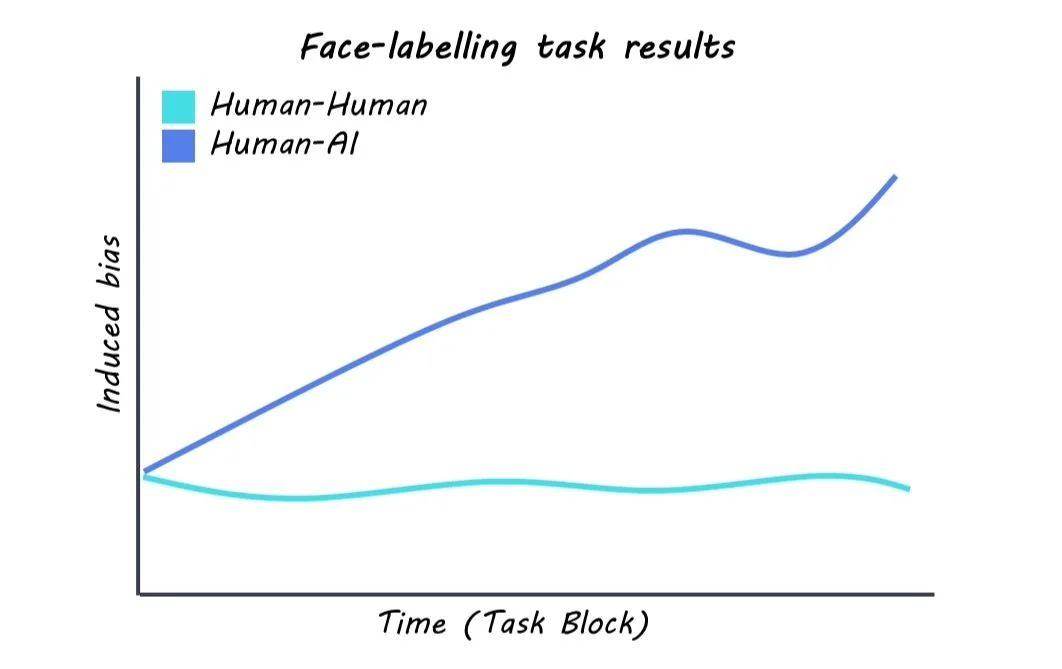
In the face-labeling series, participants initially showed a slight bias toward labeling faces as sad, but this bias gradually corrected itself throughout the trials. However, when AI was trained on this biased, human data, it reflected and amplified the bias in its responses over time. As participants evaluated their answers in collaboration with this biased AI system, they were more likely to adjust their responses to align with the AI’s outputs, which, over time, increased their own biases. This amplification of bias did not occur when participants were shown responses from other humans, indicating that human biases were more impacted by the AI system than by human feedback. Interestingly, AI’s label contributed to this effect: when researchers labeled human responses as AI-generated, participants were more likely to trust the response as correct. Interestingly, when participants were told the AI responses were human, they absorbed the bias, but to a lesser extent. 

In the moving dot series, participants were initially unbiased but developed increasingly biased responses as they interacted with the biased AI algorithm. However, participants’ answers improved in judgment and accuracy when working with the unbiased AI system. Notably, the participants were reportedly unaware of the biased algorithm’s influence over their judgment. 

Finally, in the real-world task, the authors also showed that exposure to biased AI images altered the social judgments of human participants.
What's the impact?

This study is the first to show that AI systems can reflect and amplify subtle human biases, ultimately influencing our judgments in perceptual, emotional, and social contexts. This is particularly concerning in high-stakes areas like medical diagnoses, hiring decisions, and widely seen advertisements. Greater awareness of AI’s potential to influence human judgment is needed, as is the development of measures to mitigate bias. 
Access the original scientific publication here

The Role of Mitochondria in Age-Related Cognitive Decline

Post by Kelly Kadlec

The takeaway

This study investigated how mitochondria influence cognitive decline related to aging. In addition to illuminating the molecular link between synaptic excitation and mitochondrial gene transcription, the authors demonstrate how this molecular cascade could provide a basis for treatments to improve age-related cognitive decline.      

What's the science?

A loss of energy as we age is a nearly universal experience, and a decline in cognitive function is seen as largely inevitable. It is thought that this change in the aging brain is related to changes in mitochondrial function, but the molecular underpinnings of this process have remained largely unknown. Understanding the relationship between neuronal activity and mitochondrial DNA transcription may provide key insights into the aging brain and how we might counteract functional decline by developing treatments that target this interaction. Last week in Science, Li and colleagues uncovered the molecular cascade linking synaptic excitation and mitochondrial DNA transcription and demonstrated that targeting this cascade can improve age-related cognitive decline in rodents.  

How did they do it?

The authors investigated the molecular process of activity-dependent mitochondrial DNA transcription in mice using a broad range of in vivo and ex vivo techniques. First, the authors used RNAscope and optogenetics in hippocampal brain slices along with foot-shocks and quantitative real-time PCR in vivo to establish that neuronal activity interacts with mitochondrial transcription. Then, they compared this mitochondrial expression in young and aged mice. To better understand the cause of the age-related changes they observed, they again used optogenetic and pharmacological tools to isolate a critical role for activity-dependent calcium. 

Next, they conducted immunogold electron microscopy in the hippocampus to determine whether or not this calcium dependency is regulated by calmodulin-dependent protein kinase II (CAMKII). The authors then sought to determine whether mitochondria can decode calcium activity through CRE-like sequences. They used a DNA-affinity assay to identify the presence of mitochondrial CREB and derived CREB activity sensors to directly probe its function. 

Finally, the authors used whole-cell recordings, intracellular ATP measurements, and a variety of genetic techniques to measure and modulate neuronal activity. They examined the role that activity-coupled mitochondrial transcription plays in synaptic function and regulation. They tested these findings under the hypothesis of age-related changes by investigating how inhibiting or enhancing activity-dependent mitochondrial transcription impacts association-based learning in mice of different ages.

What did they find?

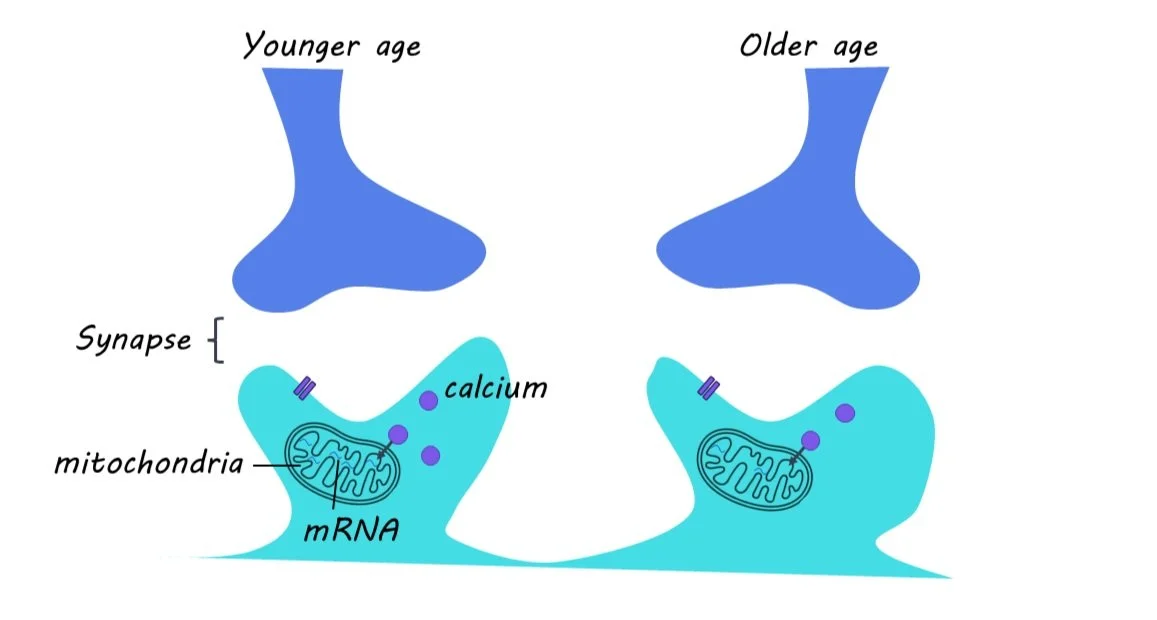
The authors first show a causal coupling between neuronal and synaptic excitation and mitochondrial DNA transcription. This expression was reduced in aged mice compared to young mice and was also associated with lower levels of activity-dependent mitochondrial calcium. The authors subsequently found that activity-coupled mitochondrial transcription relies on mitochondrial calcium.

The authors also probed the mechanisms that link neural activity with mitochondrial transcription and found that this process recruits the same molecules that have an established role in activity-transcription coupling in the nucleus. Specifically, activity-dependent mitochondrial transcription and calcium were regulated by CaMKII. Moreover, the translation from activity-dependent calcium to DNA transcription is mediated by mitochondrial CREB.

The authors also show how activity-coupled mitochondrial transcription regulates both synaptic and mitochondrial resilience, further demonstrating how this molecular process mediates both neuronal energy reserves and memory processes. Finally, they show that restoring activity-dependent mitochondrial transcription in aged mice enhances memory, suggesting a mitigation of age-related cognitive decline.

What's the impact?

Activity-dependent mitochondrial DNA transcription has long been suspected to play a critical role in maintaining neural energy reserves, and this study provides key insight into the molecular cascade underlying this process. The authors also show age-related alterations in this pathway that likely contribute to cognitive decline during aging. The authors also demonstrate that reinvigorating this pathway may reduce or even reverse age-related decline in brain function.  

Access the original scientific publication here.

How Experiencing a Negative Event Alters Responses to Others

Post by Shahin Khodaei

The takeaway

Previous negative experiences affect how mice respond to other mice in a similar state. This behavior is mediated by the corticotropin-releasing factor (CRF) system in a region of the brain called the medial prefrontal cortex.

What's the science?

As humans, we recognize the signs that another person has experienced a stressful event and respond to them, for example showing consoling or prosocial behaviors. Similar to humans, the previous experiences of a mouse can affect how it responds to another stressed mouse. These different responses may be regulated by the corticotropin-releasing factor (CRF) system in the brain, specifically in a region called the medial prefrontal cortex which is important in emotion and socialization. This week in Nature Neuroscience, Martese and colleagues investigated 1) the ways in which mice with different experiences react to a stressed mouse, and 2) the role of the CRF system in these responses. 

How did they do it?

The authors used mice as either observers or demonstrators. Observer mice were placed in a box and presented with two demonstrator mice – one that was given a stressful experience right before the test (either being restrained for 15 minutes, or getting a shock to their feet), and one that was unstressed. The authors looked at how the observer interacted with the demonstrators. In some experiments, the observer was subjected to a stressful “negative self-experience” (NSE) one day before the test. The authors compared how much the observer interacted with each of the demonstrators. 

To study whether CRF neurons in the medial prefrontal cortex played a role in the behavior of the observers, the authors used genetic techniques to add certain genes to these brain cells. These genes either 1) decreased the level of CRF, 2) caused the cells to emit light when they were activated, which could then be measured using a microscope, or 3) allowed the authors to decrease the activity of the cells using optogenetics.

What did they find?

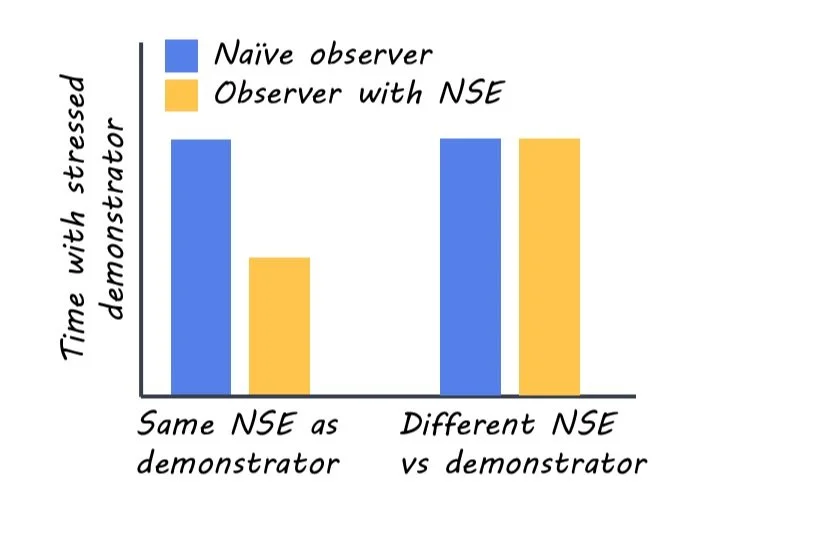
When a naïve observer was placed in front of one naïve and one restraint-stressed demonstrator, the observer spent more time sniffing and interacting with the stressed demonstrator. In contrast, if observer mice had experienced a NSE of restraint, they spent less time with the restraint-stressed demonstrator (and sometimes completely avoided them). This change in response was experience-specific. If the type of stressful experience did not match between the observer and demonstrator (i.e., one was footshock-stressed and the other was restraint-stressed), the observer with NSE behaved just like a naïve observer, and spent more time with the stressed demonstrator. This suggests mice were responding uniquely to other mice experiencing similar negative events. For male mice, the behavior of the observer with NSE depended on the social status of the mouse: dominant mice avoided the stressed demonstrator, and non-dominant mice showed no preference between the stressed and naïve demonstrator. For female mice, the behavior of the observer with NSE depended on the phase of the estrus cycle (the mouse equivalent of the menstrual cycle). 

The authors focused on the CRF system in the medial prefrontal cortex. They showed that reducing the level of CRF in these neurons made observers with NSE behave more similarly to naïve observers. The authors then assessed how the activity of these neurons changed in observers. They found that in naïve observers, the activity of CRF neurons increased when they were near the un-stressed demonstrator. In contrast, for observers with NSE, the activity of these neurons increased near the stressed demonstrator. If they reduced this CRF neural activity using optogenetics, naïve observers started to avoid stressed demonstrators (i.e., behave more like NSE observers) and NSE observers preferred stressed demonstrators (i.e., behave more like naïve observers). These results show that the CRF system is involved in how previous experiences influence the way mice approach stressed animals. 

What's the impact?

This study sheds light on the mechanisms involved in how previous experiences influence behavioral responses to stress in others. Importantly, this research reveals a neurobiological mechanism involving the CRF system for how interactions with others may differ, based on previous negative experiences.

Access the original scientific publication here.